Term vs. Whole vs. IUL: Which Life Insurance Is Actually Right for You? | Fortune Shield
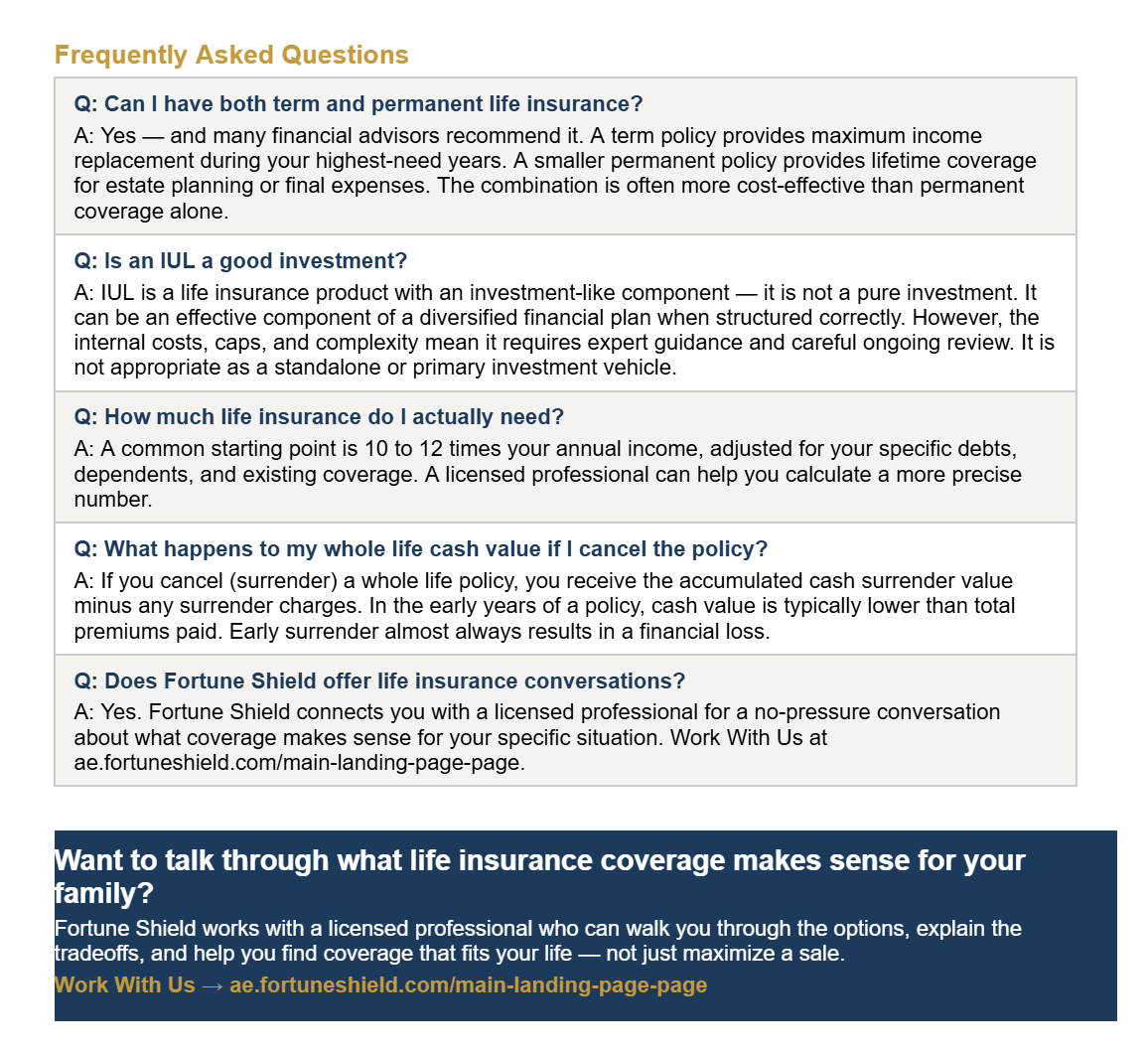
Term life insurance covers you for a specific period at the lowest cost. Whole life covers you permanently with a cash value component at a higher premium. Indexed Universal Life (IUL) is permanent coverage with cash value growth tied to a market index — the most flexible and most complex of the three. The right choice depends entirely on why you need life insurance and what you can afford. Here is an honest breakdown of all three.
Why the Confusion Exists
The life insurance industry has historically complicated this decision — partly because different products carry different commissions, and partly because the products themselves are genuinely different financial tools that serve different purposes. Most people's confusion comes from not understanding what problem each product is designed to solve.
Over 100 million Americans are either uninsured or underinsured for life insurance. Most consumers overestimate the cost of a basic term life policy by three to six times the actual price, according to the LIMRA 2025 Insurance Barometer Study.
The starting point for any life insurance conversation is not 'which type should I get' — it's 'what am I trying to accomplish.' The answer to that question determines the right product.
Term Life Insurance: Protection at the Lowest Cost
Term life insurance provides a death benefit if you die within a specified period — typically 10, 20, or 30 years. If you don't die within the term, the coverage expires. There is no cash value, no savings component, and no investment element. It is pure protection.
Premiums: lowest of all three types — often 5 to 10 times cheaper than permanent coverage for the same death benefit
Death benefit: paid to beneficiaries if you die within the term
Cash value: none
Flexibility: choose term length based on your financial obligations (mortgage payoff, children reaching financial independence, retirement)
Simplicity: straightforward — you know exactly what you're paying and what your family receives
A 20-year, $500,000 term life policy for a healthy 35-year-old costs approximately $25 to $40 per month. The same death benefit in a whole life policy may cost $300 to $500 per month or more. (Policygenius, 2025)
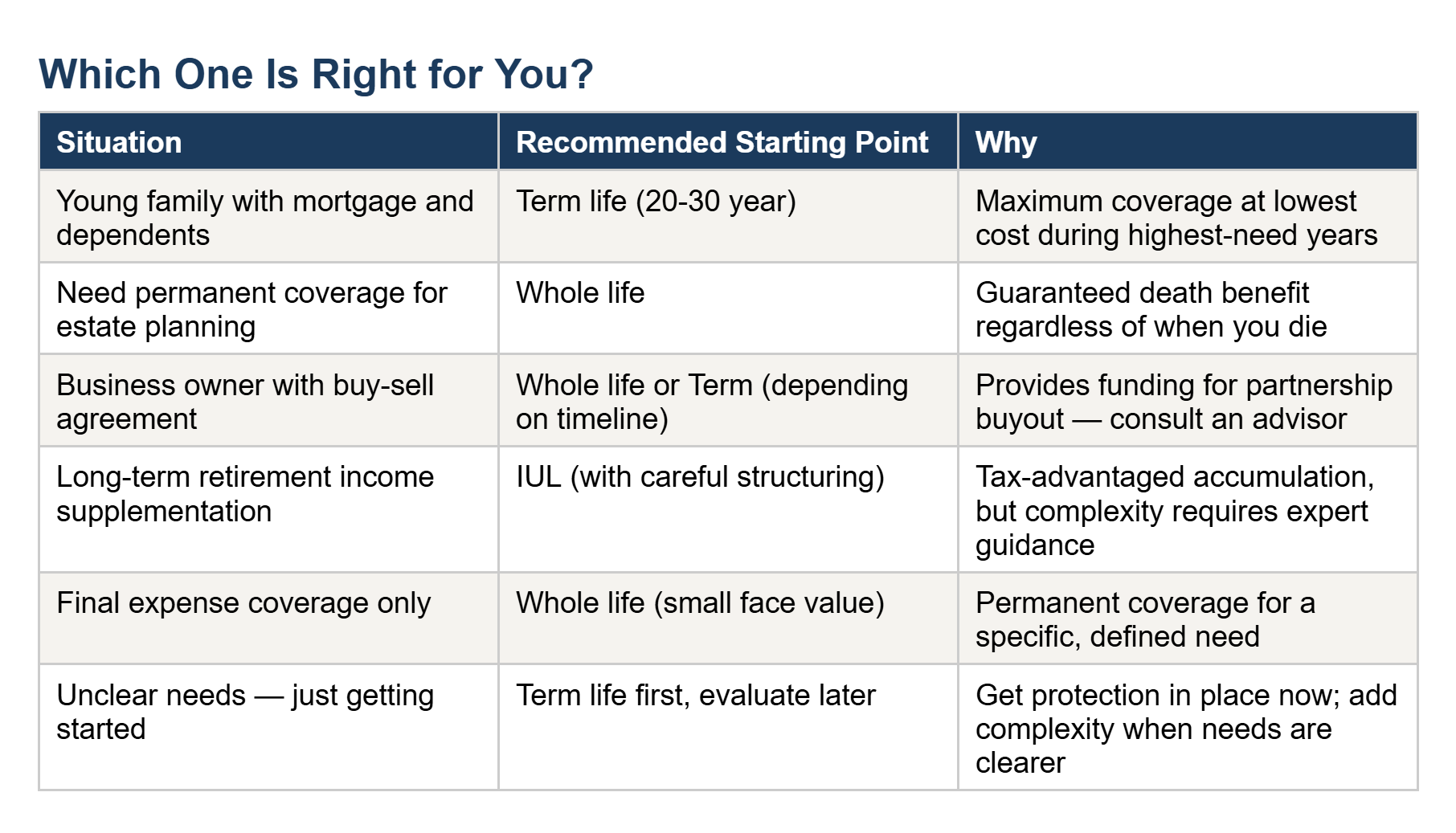
Term life is appropriate for most families with dependents who need income replacement protection during their primary working years. The goal is to have coverage while financial obligations are highest — a mortgage, dependent children, a working career — and potentially less coverage is needed after those obligations are resolved.
Whole Life Insurance: Permanent Coverage With Guaranteed Growth
Whole life insurance provides coverage for your entire life — as long as premiums are paid. It also includes a cash value component that grows at a guaranteed rate over time. The premium is fixed and will not increase as you age.
Premiums: significantly higher than term — reflects the permanent coverage guarantee and cash value accumulation
Death benefit: paid whenever you die, not subject to a term expiration
Cash value: grows at a guaranteed rate (typically 1-4% depending on the insurer), accessible via loans or withdrawals
Dividends: some whole life policies from mutual insurers pay dividends, potentially increasing cash value and death benefit
Guarantees: guaranteed death benefit, guaranteed premium, guaranteed cash value growth rate
Whole life is appropriate when permanent coverage is genuinely needed — not just during working years, but for the entire lifetime. Common use cases include estate planning, funding a buy-sell agreement in a business partnership, covering final expenses for an elderly individual, or as a long-term savings vehicle for specific planning goals.
Indexed Universal Life (IUL): Flexible Coverage With Market-Linked Growth
Indexed Universal Life insurance is a form of permanent coverage with cash value growth tied to the performance of a market index — typically the S&P 500. Unlike investing directly in the market, IUL policies apply caps (limiting upside) and floors (protecting against losses), meaning cash value doesn't lose value if the index falls but also doesn't fully capture market gains.
Premiums: flexible — you can adjust the premium amount within limits (higher than term, often comparable to or lower than whole life)
Death benefit: permanent, with flexibility to adjust
Cash value: grows based on index performance within a cap and floor structure (e.g., floor of 0%, cap of 8-12%)
Complexity: significantly more complex than term or whole life — requires careful review of policy illustrations, caps, participation rates, and internal costs
Tax advantages: cash value grows tax-deferred; loans from cash value are generally tax-free
IUL is most often used for long-term financial planning purposes alongside protection — supplementing retirement income, accumulating tax-advantaged wealth, or as a business planning tool. It requires careful structuring and ongoing management to perform as intended.
The Question Nobody Asks But Should
Before asking 'which type,' ask: 'If I die tomorrow, what does my family need?' The answer to that question almost always leads to term life as the starting point — because maximum income replacement at the lowest premium is what most families actually need most.
The other products solve specific problems. But they are rarely the right starting point for households that don't yet have basic income replacement coverage in place.
Sources Referenced
LIMRA — 2025 Insurance Barometer Study: limra.com/siteassets/newsroom/liam/2025/2025_facts_about_life_insurance.pdf
Pine AI — U.S. Life Insurance Statistics 2026: 19pine.ai/blog/us-life-insurance-statistics
MoneyGeek — Top Life Insurance Statistics of 2026: moneygeek.com/insurance/life/life-insurance-statistics
Policygenius — Term Life Insurance Cost Data 2025: policygenius.com
The Zebra — Life Insurance Statistics 2026: thezebra.com/resources/research/life-insurance-statistics


