
How Self-Employed People Should Handle Taxes and Benefits | Fortune Shield
Self-employed individuals pay 15.3% in self-employment tax on top of income taxes — effectively functioning as both employer and employee. But they also have access to deductions and tax-advantaged accounts that most W-2 employees don't. The problem: over 2 million eligible self-employed people fail to claim the health insurance deduction alone every year. This post covers the tax and benefits landscape for self-employed people in 2026 — including what most people miss.
The Self-Employment Tax Reality
When you work for an employer, your Social Security and Medicare taxes are split: you pay 7.65% and your employer pays 7.65%. When you're self-employed, you pay both halves — a total of 15.3% on net self-employment income. That's before federal or state income tax.
The self-employment tax rate is 15.3% — 12.4% for Social Security and 2.9% for Medicare — applied to net self-employment earnings. Self-employed individuals pay both the employee and employer portions. (IRS)
This reality makes strategic tax planning essential for self-employed individuals. The good news: the tax code provides significant deductions specifically for self-employed people that can meaningfully reduce this burden. Most people don't fully use them.
The Health Insurance Deduction: The Most Missed Benefit
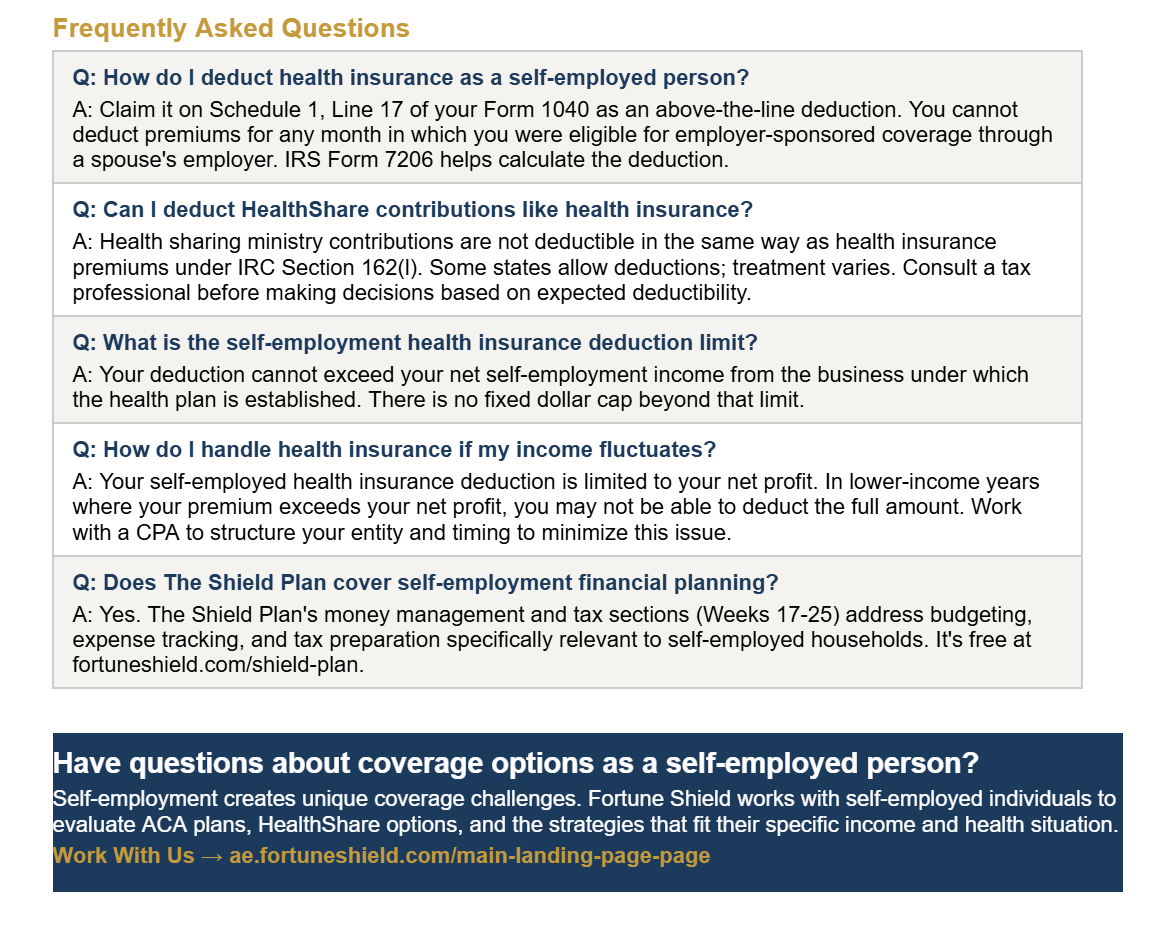
Self-employed individuals can deduct 100% of health insurance premiums paid for themselves, their spouse, their dependents, and children under age 27. This is an above-the-line deduction — it reduces adjusted gross income before the standard deduction is applied.
Over 12 million self-employed Americans claim the health insurance premium deduction annually. However, IRS estimates suggest 2 to 4 million additional eligible self-employed individuals fail to claim the deduction each year, leaving hundreds of millions of dollars in unclaimed tax benefits. (IRS Statistics of Income, cited by HealthPlusLife, 2026)
What this means in practice: a self-employed person paying $1,200 per month in health insurance premiums — $14,400 per year — and in the 22% federal tax bracket saves approximately $3,168 per year in federal taxes through this deduction alone. At the 24% bracket, that savings rises to $3,456.
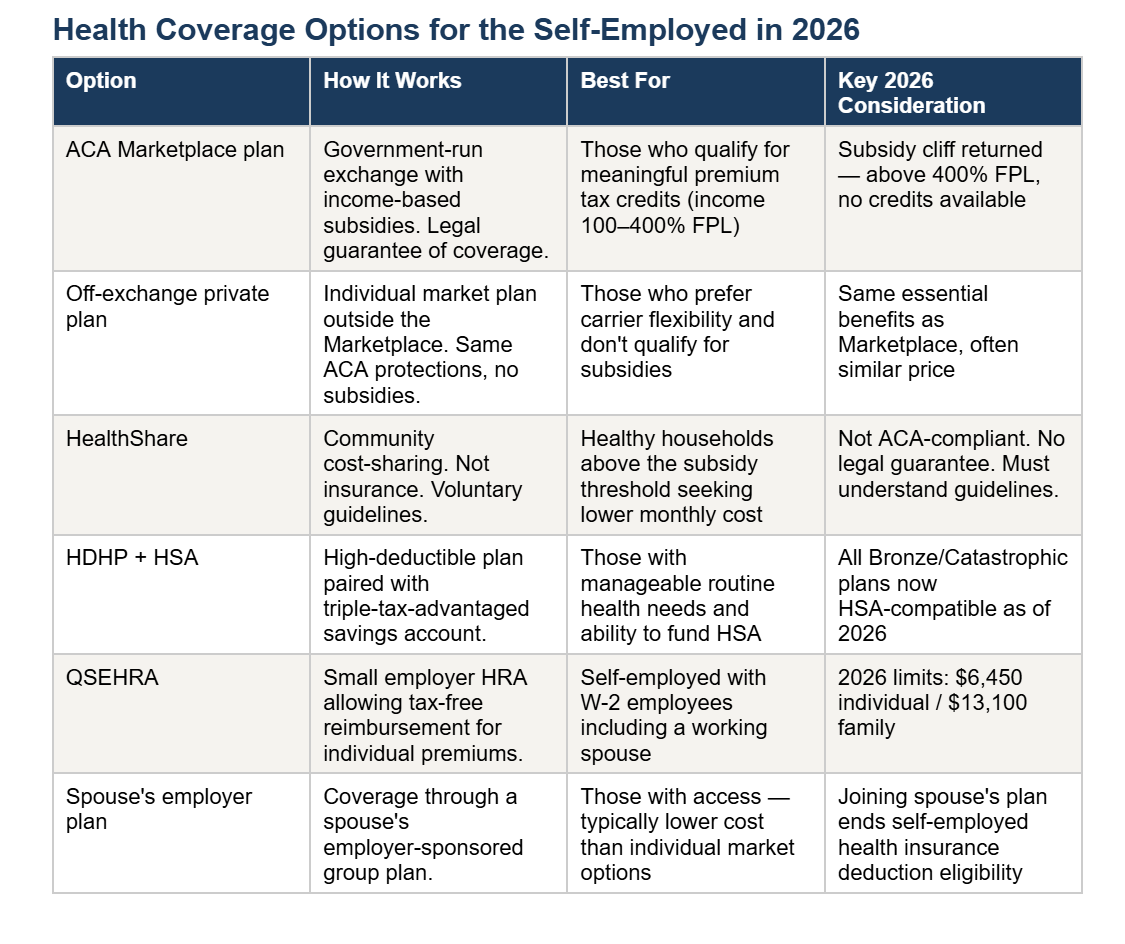
The deduction applies to ACA Marketplace plans, off-exchange private plans, and qualifying HealthShare contributions in some circumstances. Consult a tax professional for your specific situation.
The HSA: The Best Tax-Advantaged Account Most People Ignore
If you have a qualifying high-deductible health plan (HDHP), you can open a Health Savings Account — one of the few accounts that offers a triple tax advantage: contributions are deductible, growth is tax-free, and withdrawals for qualified medical expenses are tax-free.
HSA contribution limits for 2026: $4,400 for individual HDHP coverage and $8,750 for family coverage, plus a $1,000 catch-up contribution for those 55 and older. Starting January 2026, all Bronze and Catastrophic ACA Marketplace plans qualify as HDHPs, making more self-employed individuals HSA-eligible. (IRS Rev. Proc. 2025-21)
New for 2026: HSA funds can now be used to pay for Direct Primary Care (DPC) membership fees — up to $150 per month for individuals, $300 per month for families. This opens a powerful strategy of pairing an HDHP with a DPC membership, using HSA funds to cover both the catastrophic plan and routine primary care.
The Self-Employment Tax Reality
When you work for an employer, your Social Security and Medicare taxes are split: you pay 7.65% and your employer pays 7.65%. When you're self-employed, you pay both halves — a total of 15.3% on net self-employment income. That's before federal or state income tax.
The self-employment tax rate is 15.3% — 12.4% for Social Security and 2.9% for Medicare — applied to net self-employment earnings. Self-employed individuals pay both the employee and employer portions. (IRS)
This reality makes strategic tax planning essential for self-employed individuals. The good news: the tax code provides significant deductions specifically for self-employed people that can meaningfully reduce this burden. Most people don't fully use them.
The Health Insurance Deduction: The Most Missed Benefit
Self-employed individuals can deduct 100% of health insurance premiums paid for themselves, their spouse, their dependents, and children under age 27. This is an above-the-line deduction — it reduces adjusted gross income before the standard deduction is applied.
Over 12 million self-employed Americans claim the health insurance premium deduction annually. However, IRS estimates suggest 2 to 4 million additional eligible self-employed individuals fail to claim the deduction each year, leaving hundreds of millions of dollars in unclaimed tax benefits. (IRS Statistics of Income, cited by HealthPlusLife, 2026)
What this means in practice: a self-employed person paying $1,200 per month in health insurance premiums — $14,400 per year — and in the 22% federal tax bracket saves approximately $3,168 per year in federal taxes through this deduction alone. At the 24% bracket, that savings rises to $3,456.
The deduction applies to ACA Marketplace plans, off-exchange private plans, and qualifying HealthShare contributions in some circumstances. Consult a tax professional for your specific situation.
The HSA: The Best Tax-Advantaged Account Most People Ignore
If you have a qualifying high-deductible health plan (HDHP), you can open a Health Savings Account — one of the few accounts that offers a triple tax advantage: contributions are deductible, growth is tax-free, and withdrawals for qualified medical expenses are tax-free.
HSA contribution limits for 2026: $4,400 for individual HDHP coverage and $8,750 for family coverage, plus a $1,000 catch-up contribution for those 55 and older. Starting January 2026, all Bronze and Catastrophic ACA Marketplace plans qualify as HDHPs, making more self-employed individuals HSA-eligible. (IRS Rev. Proc. 2025-21)
New for 2026: HSA funds can now be used to pay for Direct Primary Care (DPC) membership fees — up to $150 per month for individuals, $300 per month for families. This opens a powerful strategy of pairing an HDHP with a DPC membership, using HSA funds to cover both the catastrophic plan and routine primary care.
Sources Referenced
IRS — Self-Employment Tax (Social Security and Medicare Taxes): irs.gov/businesses/small-businesses-self-employed/self-employment-tax
HealthPlusLife — Health Insurance Tax Deduction for Self-Employed 2026: healthpluslife.com/health-insurance/health-insurance-tax-deductible-self-employed
Jupid — Self-Employed Health Insurance Deduction 2026: jupid.com/blog/health-insurance-self-employed-deduction-2026
SelfEmployed.com — 2026 Health Insurance Premiums Jump 11%: selfemployed.com/news/2026-health-insurance-premiums
Condley & Company — Healthcare Costs for the Self-Employed in 2026: condley.cpa/healthcare-costs-for-the-self-employed-in-2026
IRS Rev. Proc. 2025-21 — 2026 HSA Contribution Limits
HSA for America — Health Insurance for Self-Employed 2026: hsaforamerica.com/blog/health-insurance-for-self-employed


