The True Cost of Being Uninsured in America in 2026 | Fortune Shield
Being uninsured doesn't mean you won't need healthcare. It means you'll pay the full cost when you do — at the most expensive possible price. 41% of Americans currently have medical debt, including many who are insured. For the uninsured, a single hospitalization can cost tens of thousands of dollars. Here is the actual financial picture of going without coverage in 2026 — and the alternatives available.
Healthcare Is the Top Financial Fear in America Right Now
For the first time on record, healthcare costs have topped the list of Americans' financial worries — above food, housing, utilities, and transportation.
Two-thirds of Americans (66%) say they are at least somewhat worried about affording healthcare costs — more than those worried about food and groceries (57%), utilities (57%), or housing costs (52%). (KFF Health Tracking Poll, January 2026)
Among uninsured adults specifically, the worry is nearly universal: 88% of uninsured adults under 65 say they are worried about affording healthcare. And their concern is not abstract — it reflects direct experience with what healthcare actually costs without coverage.
What Healthcare Actually Costs Without Insurance
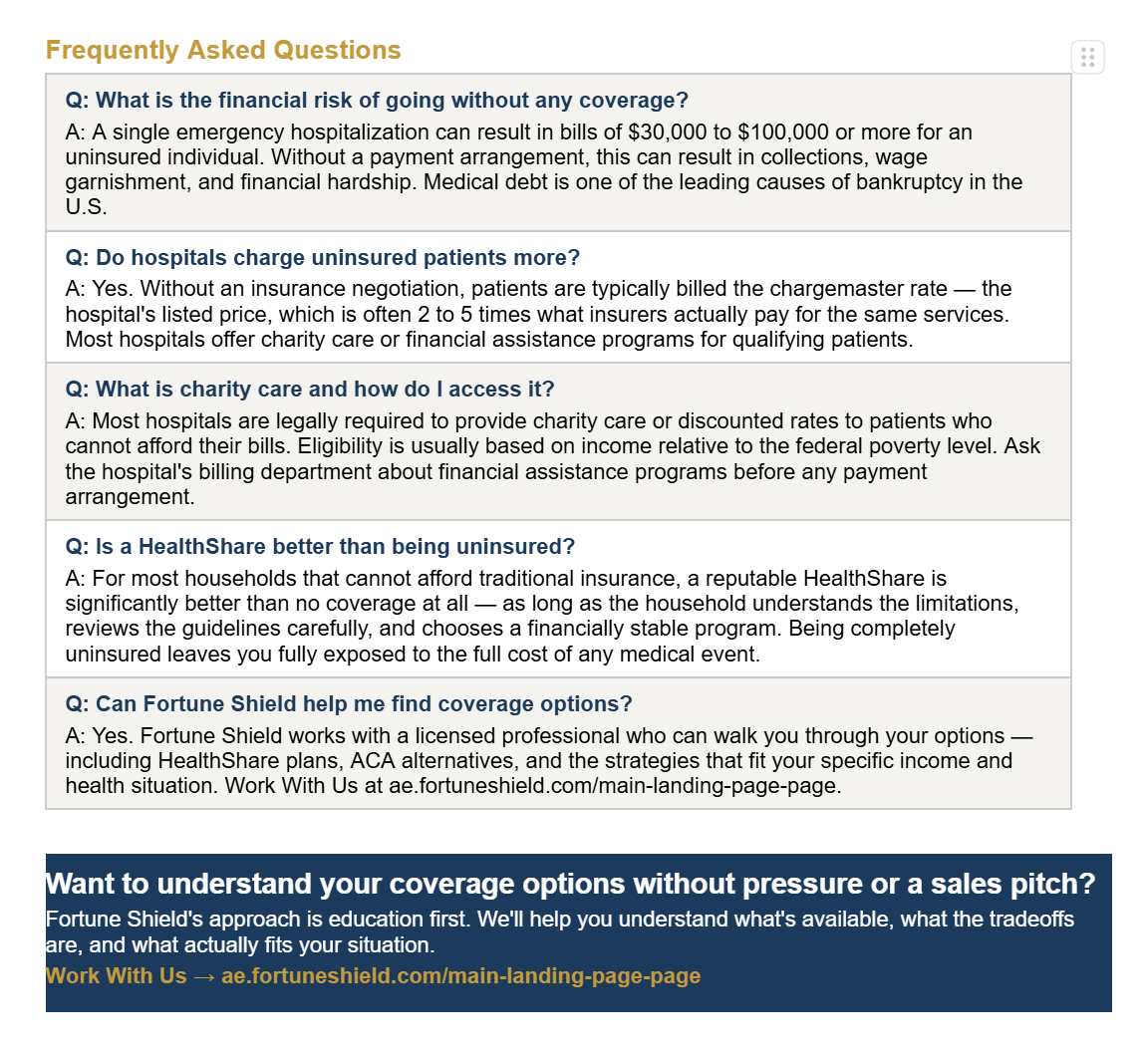
Without insurance or a cost-sharing arrangement, Americans pay the full chargemaster rate — the hospital's listed price, which bears little relationship to what insurers actually negotiate. These prices are significantly higher than what insured patients pay.
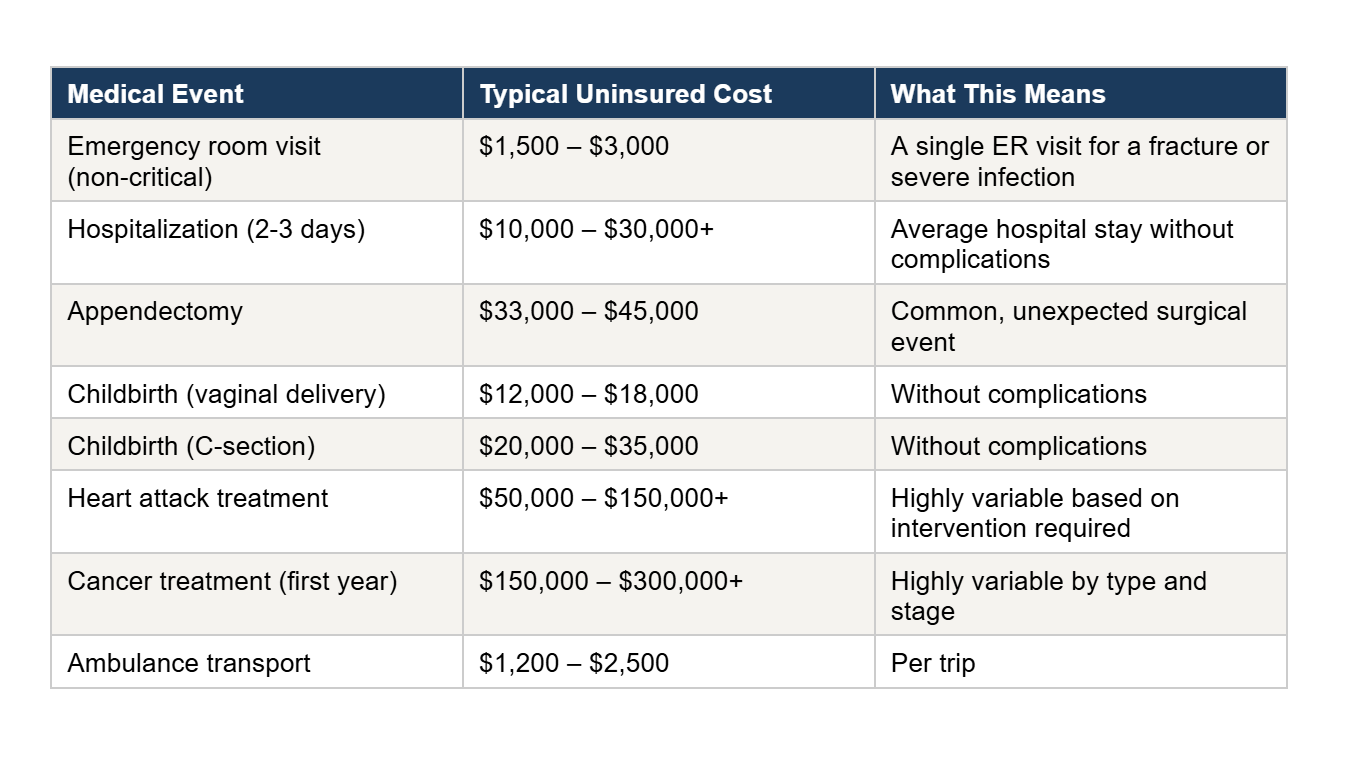
About 41% of Americans — roughly 72 million people — have medical debt or are struggling with medical bills. Uninsured adults and those with high-deductible health plans are among the most likely to carry medical debt. (Multiple studies cited in 2026 reporting from KFF and Stacker)
Medical debt is not a niche problem. It affects households across income levels, and it is one of the leading causes of bankruptcy in the United States. A single unexpected medical event is sufficient to create financial hardship for families with no coverage and no emergency savings.
The Hidden Cost: Delayed and Avoided Care
The financial cost of being uninsured isn't only about what happens when you get sick. It's also about what happens when you don't seek care because you can't afford it.
38% of Americans in 2026 have medical debt problems — a staggering figure that includes many people who do have health insurance under current conditions. (Fortunly, citing multiple sources, 2026)
Uninsured individuals are significantly less likely to receive preventive care — meaning conditions are caught later, when treatment is more expensive
24.7% of Americans postponed seeking care in the past year due to cost
About half of U.S. adults say they would not be able to pay a $500 unexpected medical bill out of pocket, including one in five who would not be able to pay it at all (KFF, 2022 Health Care Debt Survey)
The compounding effect of delayed care is one of the most significant financial risks of going uninsured. A condition that costs $200 to treat early can cost $20,000 to treat after being neglected for two years.
The ACA Subsidy Cliff in 2026
The enhanced premium tax credits that had expanded ACA subsidy eligibility from 2021 through 2025 expired at the end of 2025. For 2026, the subsidy cliff has returned: households above 400% of the federal poverty level no longer qualify for premium assistance.
This means some households — particularly self-employed individuals and families with moderate-to-higher incomes — are facing full unsubsidized ACA premiums for the first time in several years. For a family of four in this situation, that can mean $1,800 to $2,200 or more per month in premiums alone.
This is exactly the household profile for which HealthShare plans and other coverage alternatives deserve serious evaluation — not because they're equivalent to insurance, but because going uninsured is not an acceptable alternative.
Your Options if Traditional Insurance Is Unaffordable
ACA Marketplace plans with subsidies: If your income qualifies (100–400% of federal poverty level), subsidized plans may be affordable. Check Healthcare.gov to verify eligibility.
Medicaid: If your income falls below 138% of the federal poverty level in an expansion state, you may qualify for free or near-free Medicaid coverage.
Short-term health plans: Temporary coverage for specific situations. Not ACA-compliant. Significant coverage gaps. Use only as a bridge, not a permanent solution.
HealthShare plans: Community cost-sharing alternatives. Not insurance. No guarantee of payment. Can be significantly less expensive than unsubsidized ACA plans for healthy households above the subsidy threshold. Requires careful evaluation.
Direct Primary Care (DPC) + catastrophic coverage: A DPC membership for routine primary care combined with a high-deductible catastrophic plan for major medical events — a strategy gaining traction in 2026.
Sources Referenced
KFF — Americans' Challenges with Health Care Costs (updated April 2026): kff.org/health-costs/americans-challenges-with-health-care-costs
Fortunly — Statistics and Facts About Uninsured Americans: 2026 Edition: fortunly.com/statistics/uninsured-americans
Stacker / Multiple outlets — What Percentage of Americans Have Medical Debt in 2026: keyt.com/news/money-and-business/stacker-money/2026/01/24/what-percentage-of-americans-have-medical-debt-in-2026
Roosevelt Institute — The US Medical Debt Crisis: rooseveltinstitute.org/publications/medical-debt
Health Affairs — National Health Expenditure Projections 2024-2033: healthaffairs.org/doi/10.1377/hlthaff.2025.00545
HealthInsurance.org — Self-Employed Health Insurance Deduction 2026: healthinsurance.org/obamacare/self-employed-health-insurance-deduction


