
HealthShare vs. Traditional Health Insurance: An Honest Comparison | Fortune Shield
HealthShare plans and traditional health insurance both help members manage healthcare costs — but they work in fundamentally different ways, carry different legal guarantees, and fit different households. This comparison covers how each works, what each covers, what each costs, and the honest tradeoffs of both. There is no universally right answer. The right answer depends on your situation.
Why This Comparison Matters in 2026
The healthcare coverage landscape shifted significantly in 2026. The enhanced ACA premium tax credits that had expanded subsidy eligibility since 2021 expired at the end of 2025. The 'subsidy cliff' has returned: households above 400% of the federal poverty level no longer qualify for premium tax credits on Marketplace plans.
Private health insurance enrollment is projected to decline by 2.2% in 2026, largely reflecting a 12.3% drop in direct-purchase insurance as ACA enhanced subsidies expire. (Health Affairs, 2025)
For self-employed individuals, families above the subsidy threshold, and small business owners paying full unsubsidized premiums, the cost of traditional insurance has become a significant financial burden. HealthShares have grown in interest as a result — but they require careful evaluation before enrollment.
How Traditional Health Insurance Works
Traditional health insurance is a contract between you and an insurance company. You pay a monthly premium. In exchange, the insurer is legally obligated to cover your eligible claims according to the policy terms. ACA-compliant plans must cover ten essential health benefits including hospitalization, prescription drugs, mental health care, and maternity coverage.
Monthly premium: fixed regardless of whether you use healthcare
Deductible: the amount you pay before insurance begins covering costs
Copays and coinsurance: your share of costs after the deductible
Out-of-pocket maximum: the cap on what you pay in a plan year
Network: approved providers — out-of-network care may not be covered
How a HealthShare Works
A HealthShare is a membership community where members contribute monthly to a shared pool. When a member has an eligible medical need, other members' contributions are used to cover that cost — based on the program's sharing guidelines. HealthShares are not insurance contracts. Sharing is based on voluntary community guidelines, not legal obligation.
Monthly contribution: similar to a premium but called a 'share amount'
Initial Unshareable Amount (IUA): similar to a deductible — your responsibility before sharing begins
No network restriction in most programs: members can use any provider
No enrollment periods: you can join any time (some waiting periods for pre-existing conditions)
No legal guarantee of payment: sharing is community-based and guideline-dependent
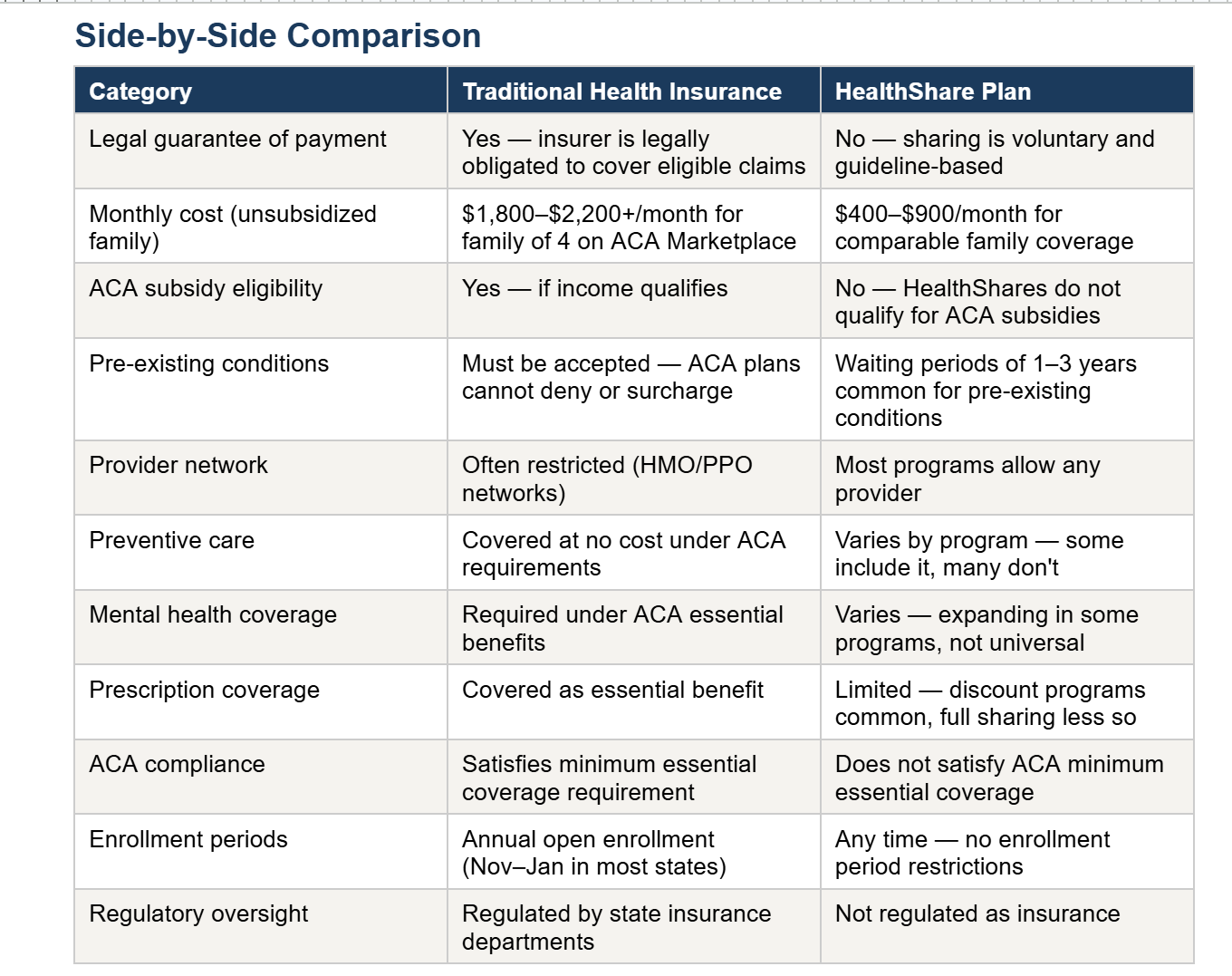
The Cost Reality for Unsubsidized Households
The cost difference between HealthShares and unsubsidized traditional insurance can be substantial. A family of four purchasing an unsubsidized ACA-compliant Marketplace plan may pay $1,800 to $2,200 or more per month. A comparable HealthShare contribution for the same family often runs $400 to $900 per month — a difference of $10,000 to $15,000 per year.
Small businesses buying ACA-compliant small group plans face a weighted median premium increase of 11% for 2026. About 10% of policies are rising 20% or more. (Kaiser Family Foundation / Peterson-KFF, cited by SelfEmployed.com, April 2026)
For households that qualify for meaningful ACA subsidies, however, the calculation is very different. A subsidized Marketplace plan may cost $50 to $200 per month for the same household that would pay $700 in HealthShare contributions — making traditional insurance the better value in that scenario.
When Traditional Insurance Is the Right Choice
You qualify for significant ACA premium tax credits based on your income
You have complex, ongoing pre-existing conditions that require immediate coverage
You rely on specific providers or specialists within an insurance network
You need the legal certainty of guaranteed payment for covered claims
You require prescription drug coverage for ongoing medications
You want ACA minimum essential coverage compliance
When a HealthShare May Be Worth Exploring
Your household income is above the ACA subsidy threshold and you pay full unsubsidized premiums
You and your family are generally healthy with low expected medical utilization
You are comfortable with community-based cost sharing and understand the lack of legal guarantee
You want provider flexibility without network restrictions
You are self-employed or a small business owner seeking a lower-cost coverage alternative
You have reviewed the specific program's guidelines and financial stability carefully
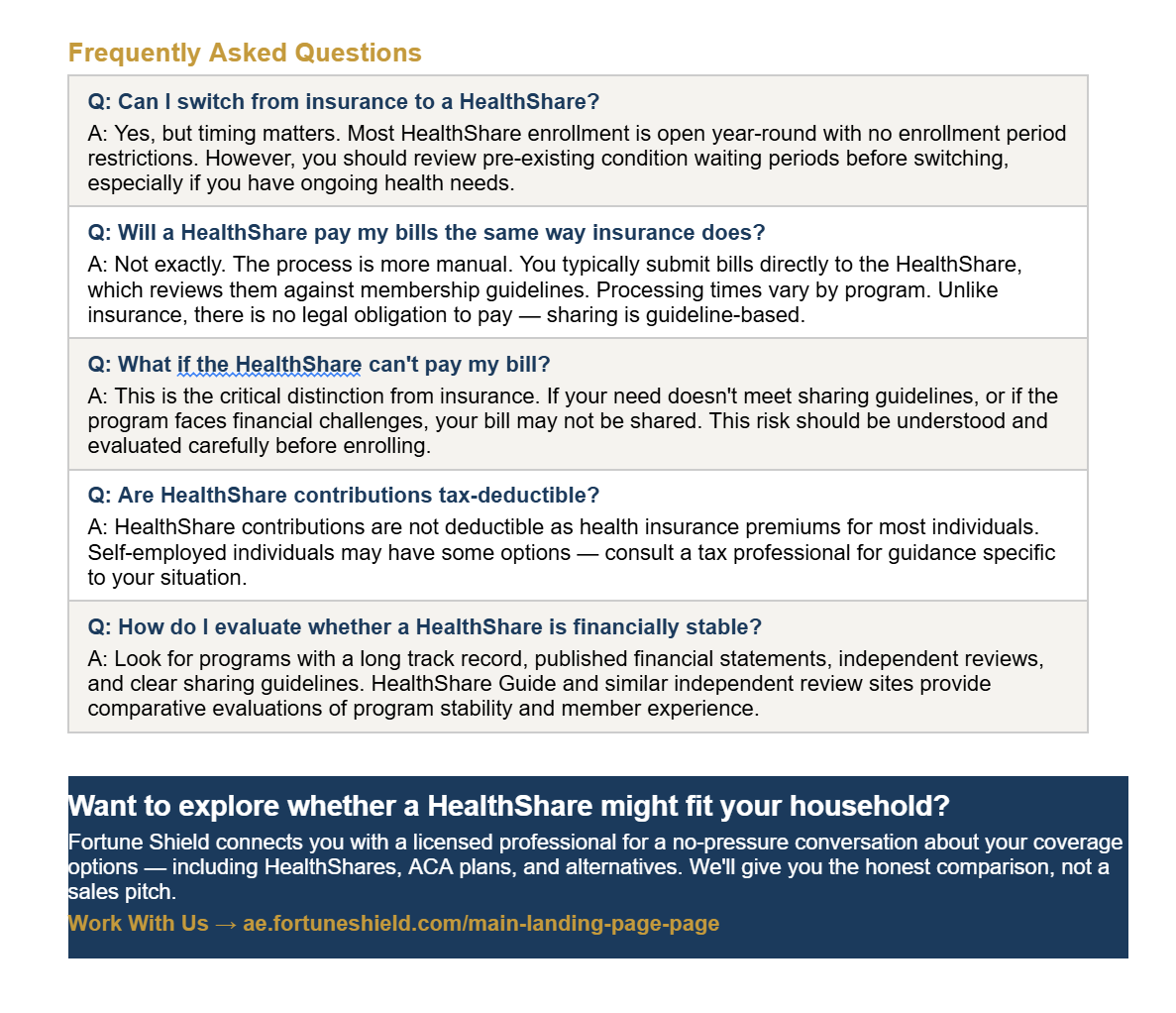
Sources Referenced
Health Affairs — National Health Expenditure Projections 2024-2033: healthaffairs.org/doi/10.1377/hlthaff.2025.00545
SelfEmployed.com — 2026 Health Insurance Premiums Jump 11% for Small Businesses: selfemployed.com/news/2026-health-insurance-premiums
HealthShare Guide — The 2026 HealthShare Guide: healthshareguide.org/the2026healthshareguide
HSA for America — Best Healthshare Plans Comparison Guide 2026: hsaforamerica.com/blog/the-hsa-for-america-healthshare-plan-comparison-guide
ColoHealth — Healthshare Plans in Colorado 2026 Complete Guide: colohealth.com/healthshare-plans
HealthInsurance.org — Self-Employed Health Insurance Deduction 2026: healthinsurance.org/obamacare/self-employed-health-insurance-deduction


