
Bronze vs. Silver vs. Gold Health Plans Explained | Fortune Shield
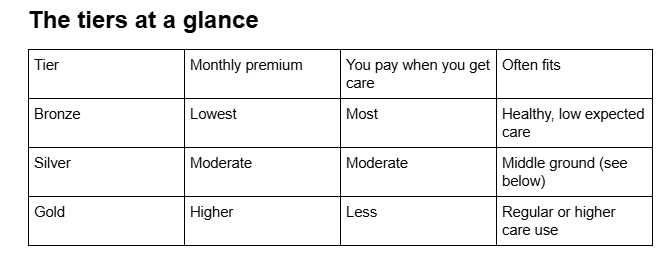
Short answer: marketplace health plans are sorted into "metal" tiers — Bronze, Silver, Gold (and sometimes Platinum) — and the tier tells you how you split costs with the insurer, not how good the care is. Bronze means lower monthly premiums but you pay more when you get care; Gold means higher premiums but less out of pocket. The right tier depends on how much care you expect to use and your budget. Here's how to choose without the jargon.
What the metal tiers actually mean
The metal level describes the balance between your monthly premium and what you pay when you use care (deductibles, copays, coinsurance). It is NOT a measure of plan quality or how good your doctors are — every tier covers the same essential benefits. It's simply a trade-off between paying more each month or more at the point of care.
Don't overlook Silver — especially at lower incomes
Silver deserves a special mention: if your income qualifies you for cost-sharing reductions, those savings are only available on a Silver plan — and they can make a Silver plan behave more like a Gold one at a lower cost. For many lower-income households, Silver is quietly the best value. This is one of the most missed opportunities in choosing a plan.
How to pick your tier
Ask yourself a few honest questions: How often do you expect to need care next year? Do you have ongoing prescriptions or a planned procedure? Could you comfortably handle a large bill if something unexpected happened? If you rarely use care and want the lowest premium, Bronze may fit. If you use care regularly or want predictable costs, Gold can be worth the higher premium. And always check whether you qualify for savings that change the math.
Premium isn't the only number
The most common mistake is choosing purely on the lowest monthly premium. A cheap premium with a huge deductible can cost far more if you actually need care. Look at the total picture — premium plus what you'd realistically pay using the plan — and match it to how you actually use healthcare.
Frequently asked questions
Is a Gold plan better than a Bronze plan? Not "better" — different. Gold costs more monthly but less when you get care; Bronze is the opposite. Both cover the same essential benefits; the right one depends on your usage and budget.
What are cost-sharing reductions? Extra savings that lower your out-of-pocket costs — available only on Silver plans and only if your income qualifies. They can make Silver an excellent value.
Which tier is cheapest? Bronze usually has the lowest premium, but it isn't always the cheapest overall — if you use care, a higher tier can cost less in total.
How do I know which tier fits me? Match the tier to how much care you expect to use and what you can handle out of pocket — and check for savings. We're happy to walk through it with you.
Find the tier that actually fits you
The right plan is the one you understand and can afford — not just the cheapest sticker price. At Fortune Shield, education comes first. Explore our health protection education (https://fortuneshield.com/healthshare-education), or schedule a no-pressure conversation (https://fortuneshield.com/schedule-a-conversation).
This article is for general educational purposes only and is not insurance, financial, tax, or legal advice. It does not create a client relationship. Plan availability, costs, and savings depend on your income, household, and state, and program rules can change. Fortune Shield is a licensed, education-first protection resource (NPN 1073776) and is not connected with or endorsed by the U.S. government or any federal or state marketplace. Speak with a licensed professional about your specific situation.


